
Behavior, not opinion
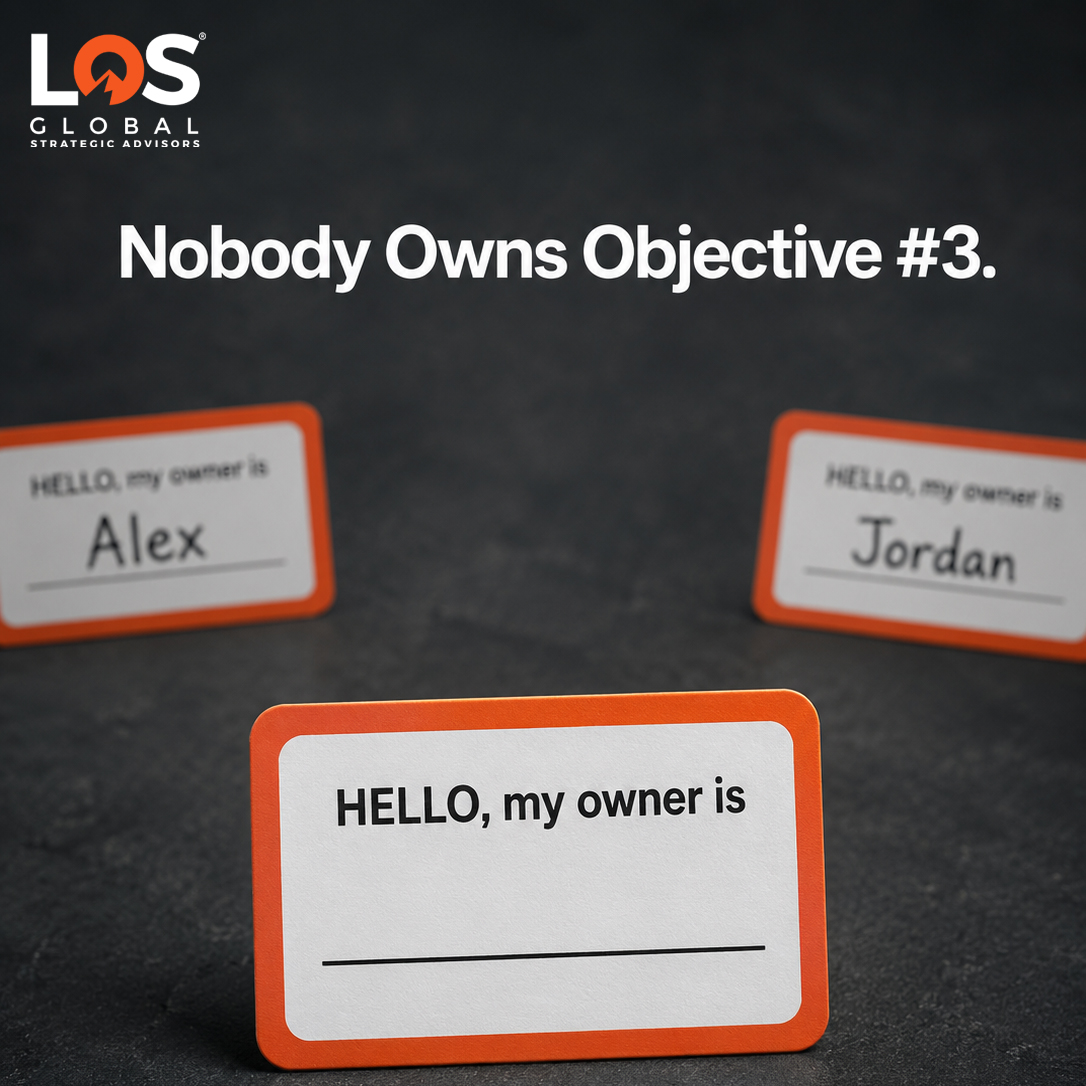
Most strategy statistics measure confidence. Someone surveys a few hundred executives, asks how execution is going, and publishes the mood. ClearPoint Strategy took a different route in 2026: an analysis of 20,582 actual strategic plans inside its platform. The findings: only about 15% of strategic initiatives are ever completed, and 77% of strategic objectives have no active owner.
Not weak ownership. No owner at all. No name attached.
Data like this matters because behavior does not flatter. The plans in that dataset were written by capable teams that intended to execute them. What the numbers describe is not sabotage but neglect: objectives that were agreed, documented, and then quietly abandoned by everyone at once.
Why assignment is not ownership
The standard response to an ownership gap is administrative. Assign names. Build a dashboard. Review quarterly. All useful, none sufficient, because ownership does not fail at the assignment stage. It fails earlier.
People do not take real ownership of objectives they cannot connect to something they believe in. You can put a name next to a line item. You cannot inject conviction into it. Conviction attaches to a destination people have genuinely seen and embraced, and when that destination lives only in the founder’s head, every objective downstream of it is an orphan waiting to happen. The 77% is not an accountability statistic. It is a symptom of vision that never transferred.
How real ownership forms
Three practices separate companies where objectives get owned from companies where they get assigned.
Show the destination before the objectives. People commit to a picture, not a spreadsheet. The vision has to be rendered in enough detail that your leadership team could describe it to a new hire and get it right.
Connect every objective to that picture explicitly. An owner should be able to say in one sentence why their objective matters to the destination. If the sentence cannot be written, the objective is either wrong or unowned by design.
Let owners re-derive, not just execute. When conditions change, an owner with the vision can adjust the route and stay accountable for the destination. An owner without it can only escalate. The difference between the two is the difference between 77% orphaned and a plan that survives contact with reality.
Ownership is downstream of vision. Fix the transfer and the accountability problem starts fixing itself.
From Vision to Scale.™
Monthly depth on the vision-to-ownership chain in the From Vision to Scale™ newsletter. [Link: newsletter coming in a week] Related reading: why 78% of companies that find product-market fit still fail to scale. [Link: 78% of companies fail to scale]

Peter Ainley is a strategy consultant and founder & CEO of LOS Global, who helps founders and CEOs of mission-driven companies close the gap between their vision and a strategy the team can actually execute, so they can scale beyond the founder. Serving clients across the United States, Canada and South Africa.
Peter helps founders sharpen the vision that built the business, align their leadership team behind it, and build the execution discipline that turns it into measurable growth – taking the vision that built the business and creating the structure that scales it.
The methodology powering his work has driven 3–4× growth across the businesses that adopt it.
Drawing on experience across eight countries and three continents as an operator, advisor, and CEO, Peter speaks the founder’s language, not the consultant’s – and he’s a co-author of Hard Work or Success: The School of Hard Knocks.
No responses yet