
The most expensive sentence in business right now is “We need an AI strategy.” Companies are acting on it at record speed, and the results are in.
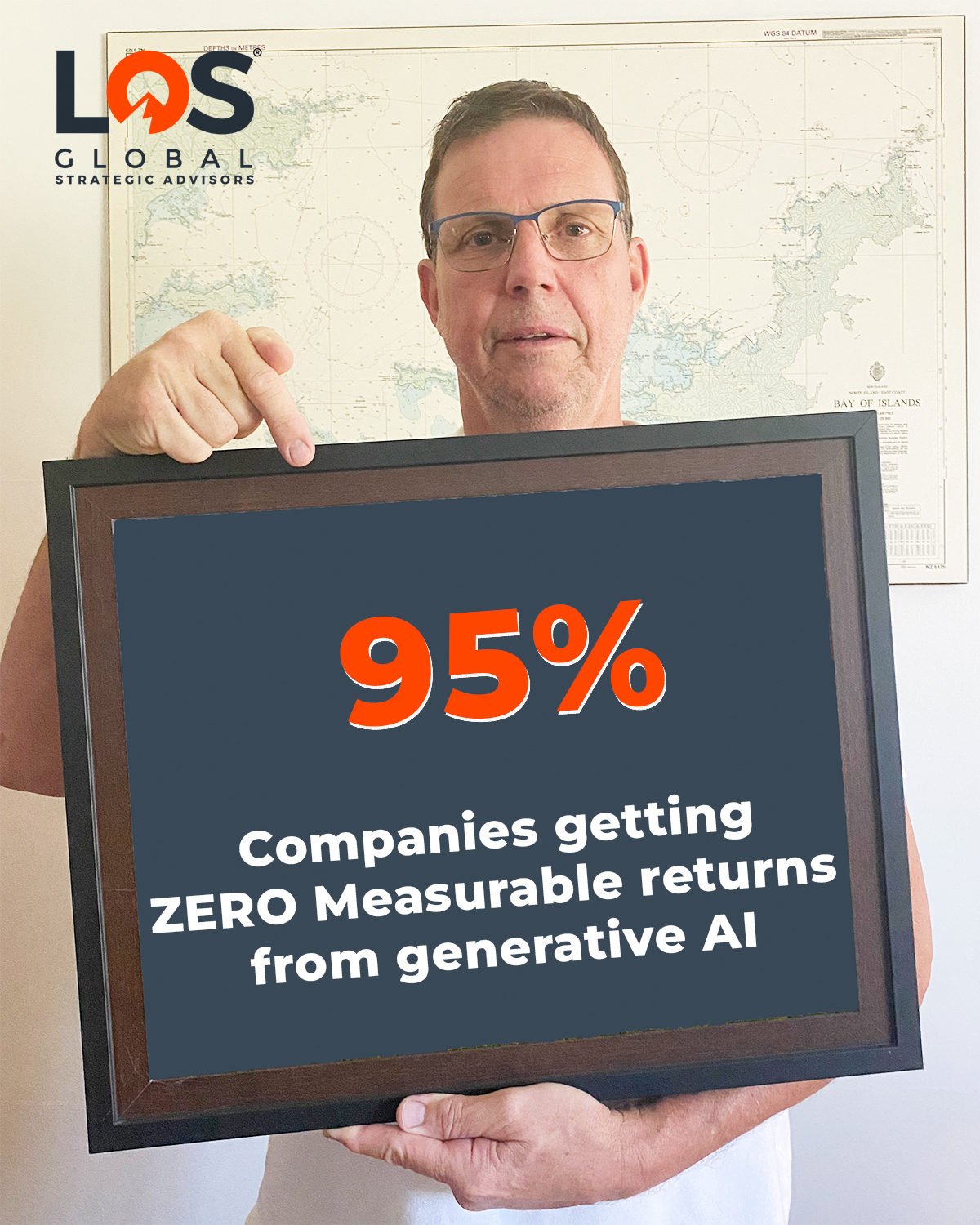
95% of organizations are getting zero measurable return from generative AI (MIT Project NANDA, State of AI in Business, 2025). Zero measurable return, after the licenses, the pilots, the task forces, and the board presentations.
What the MIT finding actually measures
The natural reading of a number like that is technical failure: the models were not good enough, the data was not clean enough, the integration was harder than promised. That is not what MIT found.
The finding is organizational. It describes a learning and strategy gap: companies deployed powerful general-purpose tools without a clear, shared answer to what those tools were supposed to advance. The technology performed. The direction was missing.
Ask a leadership team what their AI initiative is for and listen closely. “Efficiency” is a category, not an answer. “Innovation” is a hope, not an answer. An answer names the destination the business is moving toward and the specific ground the tools will help it cover.
AI amplifies whatever you give it
AI is an amplifier.
Point it at a clear, vision-built strategy and it accelerates you: faster analysis and faster cycles toward a destination everybody can name.
Point it at confusion and it accelerates the confusion, expensively and at scale.
A company without an articulated vision is asking AI to answer a question it never wrote down – it never knew how to answer. The technology performs exactly as designed. It amplifies whatever direction it is given, including no direction at all. The 95% is not a verdict on the tools. It is a verdict on the sequence deployed: tools first, direction never.
The order that fixes it
AI is a tool, not a strategist. Nor a strategy!
Vision tells the humans where to go. Strategy translates that destination into direction. Only then does the technology have something to amplify. Three checks tell you whether your business is ready to be on the right side of the 95%.
The one-sentence test. Can you say, in one sentence, where the business is going? Not a mission statement – a destination, concrete enough to steer by.
The leadership echo test. Ask three leaders the same question separately. If you get three different answers, the vision has not transferred, and AI will amplify three different directions at once.
The derivation test. For every AI use case on your list, complete this sentence: “This moves us toward the destination by ___.”
A use case that cannot complete the sentence is a cost looking for a justification.
Pass all three and AI becomes what it was always supposed to be: an accelerant on a journey you have already defined. Fail them and the smartest tools money can buy will simply help you drift faster.
Vision first. Strategy second. Execution third. In that order. Always. The technology comes fourth, and it is very good at its job – once it has one.
From Vision to Scale.™
The From Vision to Scale™ newsletter goes deeper on vision-first strategy each month. The first issue, publishing this week, takes on the problem behind the 95%. [Link: newsletter subscribe] Related: why a strategy problem, a leadership problem, and an operations problem are usually one problem. [Link: blog post]

Peter Ainley is a strategy consultant and founder & CEO of LOS Global, who helps founders and CEOs of mission-driven companies close the gap between their vision and a strategy the team can actually execute, so they can scale beyond the founder. Serving clients across the United States, Canada and South Africa.
Peter helps founders sharpen the vision that built the business, align their leadership team behind it, and build the execution discipline that turns it into measurable growth – taking the vision that built the business and creating the structure that scales it.
The methodology powering his work has driven 3–4× growth across the businesses that adopt it.
Drawing on experience across eight countries and three continents as an operator, advisor, and CEO, Peter speaks the founder’s language, not the consultant’s – and he’s a co-author of Hard Work or Success: The School of Hard Knocks.
No responses yet